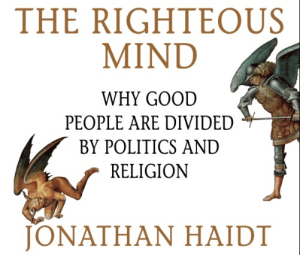
A Summary of “The Righteous Mind” by J. Haidt

JH

In his work “The Righteous Mind: Why Good People are Divided by Politics and Religion,” social psychologist Jonathan Haidt coins the term “the rationalist delusion” to explain a tendency of a majority of scholars to overemphasize the importance of rationality in human behavior throughout history (103). Haidt claims that the “worship of reason,” particularly within the realm of morality, is essentially inappropriate and he utilizes the rest of his book to advocate for a different version of moral reasoning and decision making processes based more on emotive intuitions that are dominant (103).

Continue reading

The Nature of Communication between Physician and Patient in Western Medicine

One feature of Western medicine’s social institution that serves to maintain authority/power in the hands of the physician is insulating the layperson from properly understanding what may be ailing him/her. Illich defines this process as “medical mystification” (80). It is an intellectual obscuring of sorts and stems from the physician’s special knowledge and training as it pertains to the proper functioning of the human body.

The other part of this insulation between the patient and the physician lies in the style of communication between the two. In referring to this style, or mode, of communication one must not only look at the vocabulary utilized by the physician but also at the structure of conversation between the patient and physician such as when the former enters into a hospital for medical purposes.

Continue reading

Power and Authority in the Patient/Physician Relationship in Western Medicine

The largest disparity between position in the social hierarchy of Western medicine is between the patient and the physician. The patient/physician interaction is critically shaped by the rigidity of the social hierarchy. In describing the nature of the patient/physician relationship, Parsons lays out four distinct features that establish and maintain a particular form of the subordinate/superior relationship, most commonly expressed in terms of power/authority.

Before going further, an extremely important distinction must be drawn. Power and authority are, categorically, not the same things. For instance, in at least one form, the legitimization of authority allows one to exercise more power. Authority therefore enhances elements like one’s reputation or one’s social standing. Authority, also, could be viewed as an entirely different form of power. Whereas power may stipulate the explicit use of force/coercion (i.e. violence), authority may stipulate a softer version of that with similar end results but without the use of force/coercion. Instead, psychological mechanisms and tools may be utilized. I don’t want to go too far down the rabbit hole on this, but suffice it to say they are conceptually and logically distinct and should be kept that way for current purposes.

In this case, the physician is bestowed with authority through his/her extensive knowledge of the human body, coupled with the recognition of the former by the social structure known as medical school. The authority of the physician allows him/her to suggest, recommend, and, in some cases, command the patient to complete or permit certain actions.

Continue reading

A Historical Primer on Polygamous Marriage

    45b Capture

The history of polygamy is a rich and varied one. Dating back to 3000 BCE and continuing today, spanning the world from Asia to Europe, from Africa and the Middle East to North America. The ancient patriarchs of the Hebrews such as Abraham, Esau, and Jacob were the heads of polygamous households. Similarly, under Shari’ah Law in Islam, a man is allowed to marry up to four women so long as he treats them in an egalitarian manner. Even the father of early modern Protestantism, Martin Luther, admitted that Christianity and polygamy were not mutually exclusive ideals, noting that the practice did not contradict anything in the Holy Bible (Swisher 3-4). As a result, it is fair to say that there is a globally attested and historical tradition of polygamy and that it has been defended over time as a viable form of marriage.

Continue reading